$67K a year for college made me pause. So did that $2K copy course. Here’s how I decide what’s actually “worth it.”
My son got his first college acceptance email this week (& took TWO FULL DAYS to tell me in true teenage boy fashion).
Cue the tears. The squeals. The “Why didn’t you tell me sooner?”
It was one of those moments where time just stops, until the tuition bill slapped me back into reality.
Because the average cost of attendance at this private university? $67,000 per year. No in-state tuition. No price breaks. Just straight-up sticker shock.
Almost $300,000 to graduate before he’s made a single dollar.
I looked at him and said, “How do we justify that?”
It’s a question I’ve been asking a lot this week, not just about college, but about everything that’s landing in our inboxes right now.
Discounts. Courses. Programs. Promises.
“This will 10x your audience.”
“You need this to hit your 2026 goals.”
“If you don’t buy now, you’ll fall behind.”
Fortunately, we already know the truth: more isn’t always better. And investing more doesn’t always mean growing more.
So before you click “Buy Now” this Black Friday, I want to offer a different kind of checklist, one I learned from doctors, not marketers.
It’s called the AED Framework.
Yes, like the defibrillator.
Because sometimes your business doesn’t need new software.
It needs a pulse check.
The AED Framework: A 3-Part Black Friday Biz Checkup
A is for Awareness
(Because attract sounds a bit too hands-off for my liking)
What we actually need is awareness.
Awareness of your message. Your offer. Your existence.
According to Rocket SaaS’s breakdown of the Buyer Journey Pyramid:
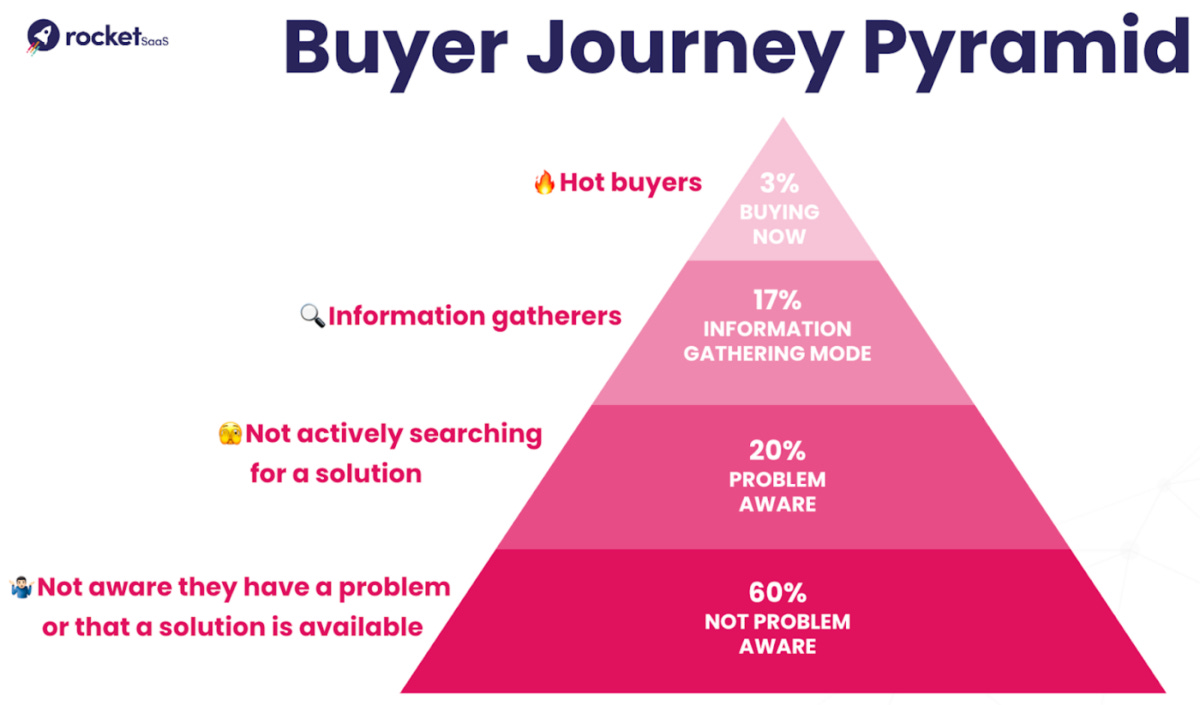
98% of your market isn’t buying today (but could in the future).
Rocket SaaS puts it plainly:
“If you only create content and messaging for the 2% of people who are ready to buy now, you are ignoring 98% of your market.”
So your job isn’t just to show up when you’re launching.
It’s to consistently educate, inspire, and signal your relevance.
Enough might look like:
- Sharing your story in one op-ed or podcast guest interview per month
- Having a simple lead magnet funnel running in the background at all times
- Curating your audience with personalized connection requests on LinkedIn
Think of it like tilling the soil before you plant seeds. Awareness isn’t about virality. It’s about setting the stage for viability.
E is for Engage (or Educate)
Once you’ve caught their attention, how are you helping them move forward?
Most of your audience isn’t ready to buy, but they are ready to learn.
That’s where engaging, educational content comes in. Especially during the consideration stage, when people are weighing their options.
Salsify explains it well:
“During the consideration stage, customers need helpful information that enables them to move to the next stage of the funnel to make an informed purchasing decision. This kind of content typically describes to customers how a brand’s product can solve a problem they likely have.”
This can look like:
- Sharing how you’ve helped someone like them
- Explaining your process in simple, practical terms
- Writing case studies or behind-the-scenes breakdowns
This is your prime time.
Not the hard sell. Not the humble brag.
But the bridge that carries people from curious to confident customers & clients.
Enough might look like:
- A company blog with stories and strategies
- A weekly email answering real client questions
- A quarterly town hall, live training or roundtable discussion
Engagement is more than a like on social. It’s the shift that happens in their mind when they feel seen, understood, and supported.
D is for Deliver
Now the final lever: how are you delivering what you’ve promised?
Tools won’t save a broken system. No amount of tech or automation makes up for confusion or chaos.
And expectations are rising.
According to Forrester research, over one-third of buyers report that the B2B buying processes they encounter fail to meet their expectations. In the same study, 62% of buyers said they expect more personalization, and 45% expect more advanced digital experiences.
That’s not about bells and whistles. That’s about clarity, ease, and trust.
This Black Friday, invest in what supports your delivery, not just what sounds exciting.
For the curious, my own pre-planned “yes list” includes:
- Kit (*60% aff link)
- Butter or Google Meet (Zoom fatigue is real)
- A K-Beauty Advent Calendar, Dossier, and Tatcha
- Subscriptions I already use that offer annual deals
- AppSumo purchases I earmarked earlier this year
I make those decisions based on plan, not pressure.
Not because of a countdown clock.
Not because someone said it would change my life.
But because I was already going to buy, and it just made sense to wait for the sale.
The “Buy Now” Gut Check: A 3-Step Pause Before You Purchase
If you’re hovering over a Black Friday “Buy Now” button, ask yourself:
- Did I plan for this?
If this tool, course, or program wasn’t on your radar before today, pause.
Impulse buys lead to guilt. Planned purchases lead to progress. - Do I have the time and bandwidth to use it now?
If not, it will just gather digital dust.
There’s no reason to buy a scaling program when you’re still figuring out your offer. Buy it when you’re ready to implement it. - Am I acting from power or panic?
Take a deep breath.
Are you grounded? Or are you afraid of missing out?
If you can honestly say:
- Yes, I planned for this.
- Yes, I have the capacity to use it.
- Yes, I’m acting from a position of power.
Then buy with confidence.
Otherwise? Back away slowly from the cart. Put your hands where I can see them.
You’re not behind, you’re building intentionally.

What If You Feel Guilty for Not Buying?
Then this is for you.
- You don’t need to keep up with anyone else’s pace.
- You don’t need to feel bad for skipping a sale. It won’t ruin your business or brand.
- You don’t need to buy something just to soothe the feeling that you “should” be doing more.
If you already have enough, you have enough.
And if you’re not sure what “enough” looks like?
Let’s fix that.
Click through and join the waitlist.
Inside my advisory, we work 1:1 to reverse-engineer your numbers, simplify your client flow, and give you a strategy rooted in clarity, not chaos. It might be the first time you leave a call with a shorter to-do list.
Because we don’t buy to keep up.
We invest in our own definition of up.
Final Word
That $67,000 tuition made me pause.
So did that $1,200 sales bootcamp.
And that $97 template bundle.
So if you’re overwhelmed:
- Turn off notifications.
- Forgo the flash sale.
- Delete the apps.
You’re not missing out.
You’re standing in your power.
You’re choosing enough.
And that’s more than enough.
Sources
- Rocket SaaS. “Why 95% of Your Audience Isn’t Buying (And How to Fix It)”
https://rocket-saas.io/blog/why-95-of-your-audience-isnt-buying-how-to-fix-it - Salsify. “Consideration Stage – Glossary”
https://www.salsify.com/glossary/consideration-stage-meaning - Shopify. “B2B Ecommerce Workflow”
https://www.shopify.com/enterprise/blog/b2b-ecommerce-workflow - HubSpot. “What Is the Buyer’s Journey?”
https://blog.hubspot.com/sales/what-is-the-buyers-journey - DMA. “Email Benchmarking Report (2021)”
https://dma.org.uk/research/email-benchmarking-report-2021
If today’s post hit home, let’s keep the conversation going. You can:
- Complete my quick subscriber survey so I can shape future posts around what you (I’ll donate $100 to Kiva for every 100 responses)
- Get ROLO, your free Digital Social Selling Advisor (a GPT to help you GTD)
- Join the waitlist for my 1:1 advisory if you’re ready for a system that sticks